Short answer: A Motioneed film doesn't use one fixed rhythm. The pacing comes from the kind of product your site describes. Developer tools and infrastructure get calmer, longer holds. Product SaaS sits in the middle. Consumer and creative brands can cut faster. The shot types follow the same read. Before a film is shown to you, every candidate cut goes through measured frame checks and a vision review. A cut with clipped type, an empty frame, a whole-page screenshot or a sentence caught mid-typing is rejected rather than shipped.
The problem with one rhythm for every site
Most template video tools have a single tempo. A database, a sneaker shop and a design tool all get the same three-second cuts and the same swoosh between them. It's efficient, and you can feel it. An infrastructure product cut like a fashion reel looks nervous. A consumer brand cut like an API reference looks asleep.
We wanted the cut to feel like it belongs to the product. That means pacing is a design decision made per film, not a global constant.
How pacing is chosen
The pacing envelope is a function of industry, tone and format. It is not a table of favourite websites, and it is not the music's BPM.
Industry is read from the words already on your site:
| Industry | Recognized by | Beats per cut (center) | Transitions on product shots | Arc |
|---|---|---|---|---|
| Devtools / infra | api, sdk, database, deploy, infrastructure | about 5.5 | cut, push, full-frame wipe | open → hold → hold → proof → act |
| Product SaaS | most other work tools | about 4.5 | cut, push, mask | hook → hold → build → burst → hold → CTA |
| Consumer / creative | video, music, fashion, shop, bold registers | about 3.5 | cut, whip, zoom | hook → hold → build → burst → hold → CTA |
Under that sit three pacing profiles: calm (6 beats per cut), standard (4.5) and energetic (3). Each industry chooses from the profiles that suit it. Devtools and SaaS use calm or standard; consumer uses standard or energetic.
Tone shifts the film inside its row without changing the row. A dark page picks the dark grade; a light open and end stay on a light paper.
Format scales the plan. A 9:16, 15-second film keeps a six-shot cap and a tight word budget for the opener. A 16:9, 30-second film has room for more holds.
Music decides where the energy lands in the arc. It doesn't change the row. A fast generated score under a devtools film doesn't turn the picture into a whip montage.
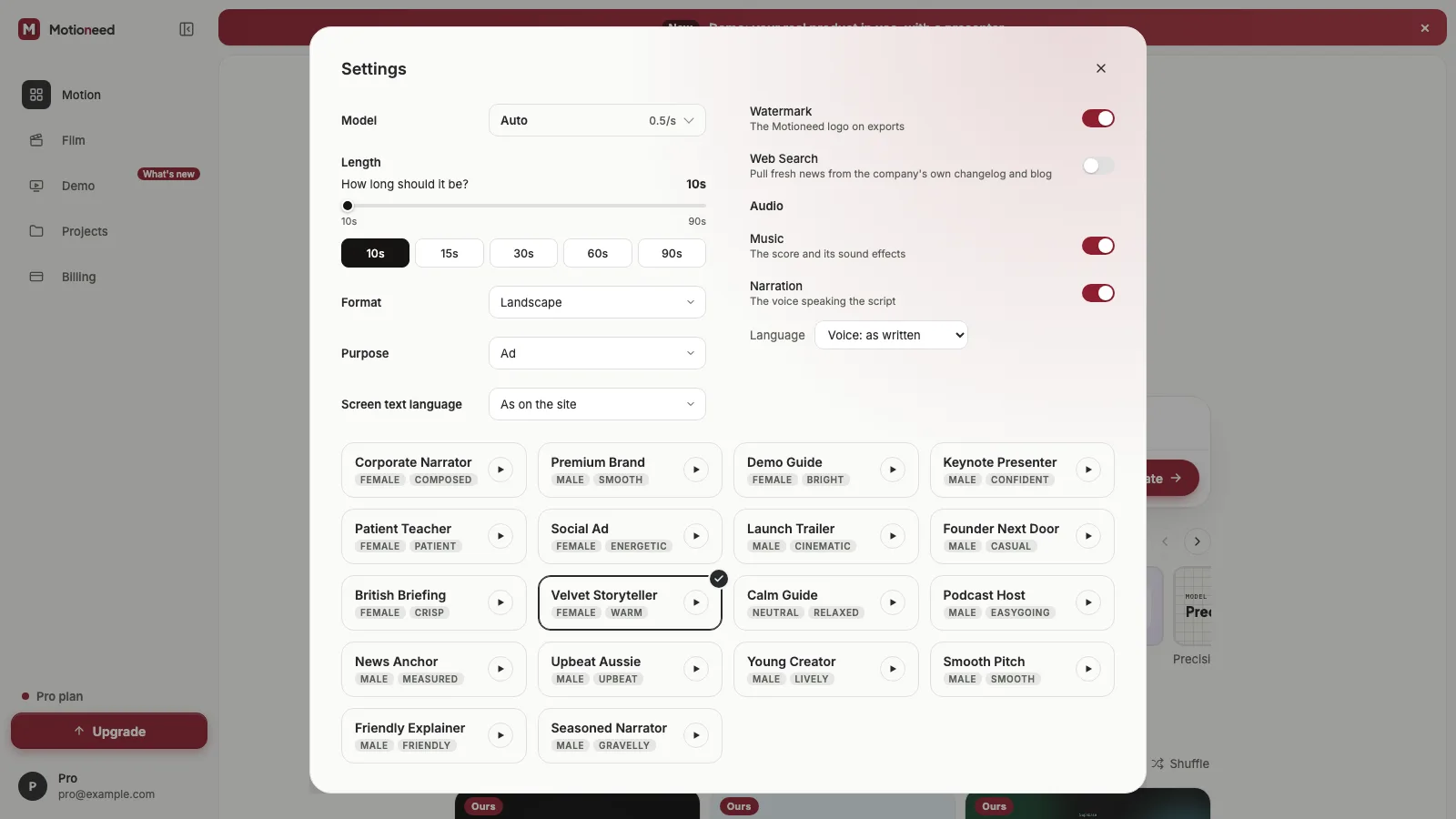
On a paid plan, if a film feels too fast or too slow, you can ask for "slower" or "more energetic" in a revise. That steps the profile down or up instead of rewriting the film.
Shot types follow the product
The shot grammar has a small set of designed shot types, filled from your real assets:
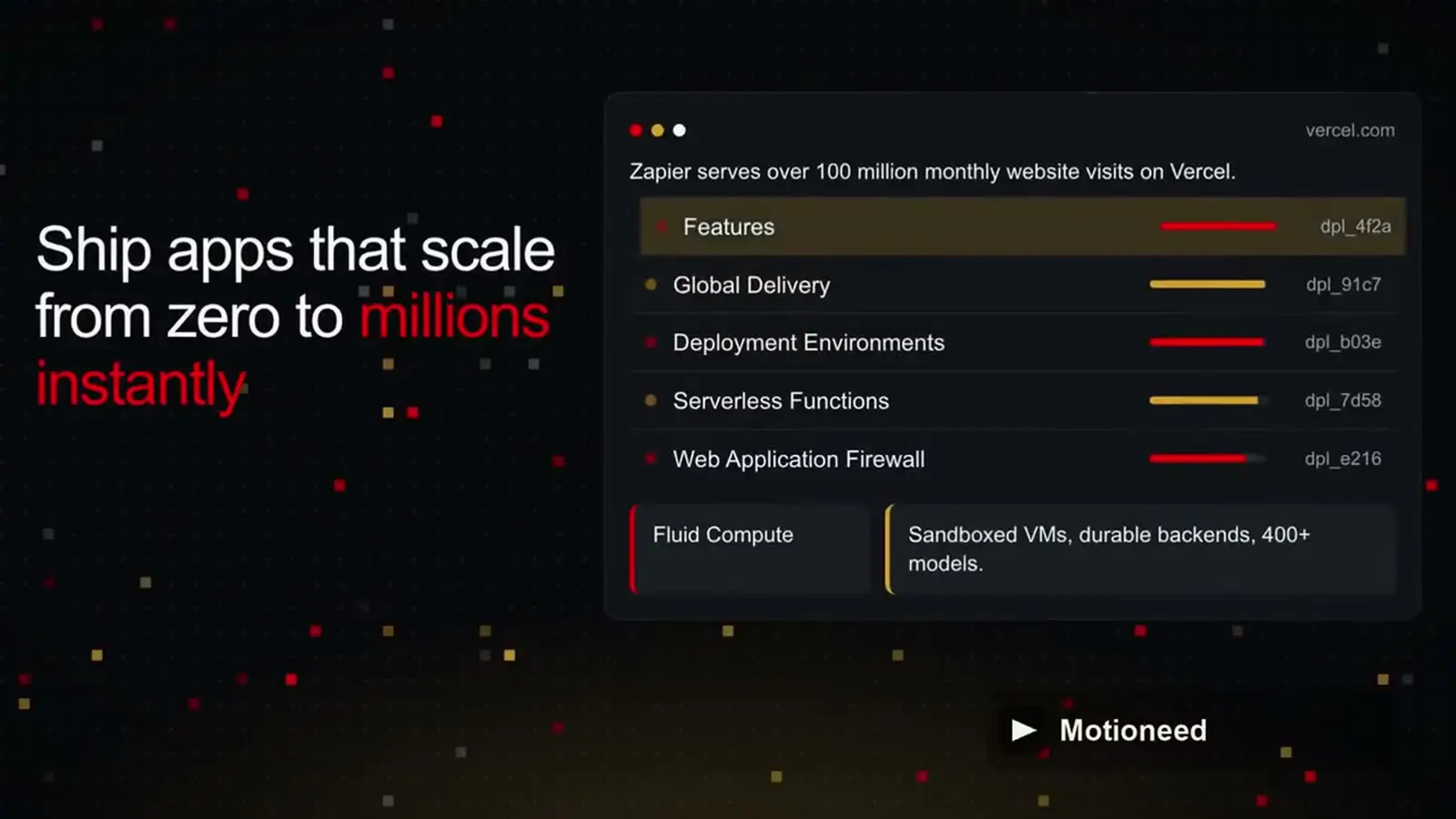
- Product push-in: one grounded region of your UI, with a camera move that ends before the frame settles.
- Split: that region beside a headline.
- Feature grid: several short labels in one column-consistent layout.
- Kinetic type: a line set large, used for at most two shots per film.
- Logo lockup: your wordmark, used for the open and the end card.
When your site offers enough grounded regions or curated stills, at least 60% of shots show one. A devtools film leans on push-ins and splits of code, tables and dashboards. A consumer film can use more of its curated imagery and shorter holds. Lines and regions are deduplicated, so a film doesn't reuse a crop or repeat a sentence.
Quality gates: rejected beats shipped
A film can be well paced and still have broken frames. So every candidate cut goes through gates before you see it. The gates run on the live render path, the same one your film takes.
Measured checks run on the rendered frames:
- Type is measured in the font the browser actually draws, and has to sit inside the safe area. Wordmarks stay at least 120px.
- Checkerboards and flat plates are detected on decoded images and CSS backgrounds, not only on files.
- A screenshot that fills the frame, or a region that is still the whole page, is not a focal crop.
- An illegible title is a blocking fault.
When the frame is judged matters as much as what is checked. Frames are sampled 50ms before each cut, after typing has finished and before the hand-off to the next shot. A sentence still being typed out can't slip through as a "complete" frame, and a transition cover can't hide a broken one. We removed the wipe and shutter covers from the live compile for the same reason, and the opener now finishes typing early.
A vision review looks at the contact sheet. A note that names a clipped, uncropped, empty, truncated, duplicated, narrow or mid-typing frame rejects the candidate. A review that can't be parsed is retried once and then rejects the cut. It never waves it through.
Repair is per shot. When one shot fails, only that shot is refit or swapped for a fitted type card, and the take is measured again. The rest of the cut stays.
If no candidate passes, Motioneed doesn't hand you a broken film. The job ends with a clear "nothing was rendered" reason, and credits for a failed video are given back.
Record and replay
The gates have to behave the same way in development as in production. So a live run can now be recorded: each model response is saved in call order. The same pipeline can then be replayed from that transcript, with the real crawl pixels, without calling the network. When a live film fails a gate, we replay it, fix the cause and verify against the exact same inputs before shipping the fix.
What this means for your film
- The rhythm fits the product: calm where the proof needs reading time, faster where the brand is built for energy.
- The shot types show your real UI first, with type only where it earns the frame.
- You won't get a cut with a clipped headline or a half-typed sentence. The film is rejected and retried instead.
The honest trade-off is that strict gates reject more drafts than a template tool would. Sometimes a film takes another pass, or a site with little product imagery gets a simpler cut. We think that beats shipping a broken frame under your logo.
FAQ
Why does my devtools film feel slower than a consumer brand's?
Devtools and infrastructure films use calmer profiles with longer holds, so code, tables and dashboards have time to read. Consumer brands can use the energetic profile.
Can I make my film faster or slower?
Yes, on a paid plan. Ask for "slower" or "more energetic" in a revise and the pacing profile steps down or up.
What happens when a frame fails a quality gate?
Only the failing shot is repaired or swapped for a fitted type card, then the take is checked again. If no candidate passes, nothing is shipped and the credits come back.
Does the music decide the cut speed?
No. Music decides where the energy sits in the arc and where cuts can land on the beat. The pacing row comes from the product, the tone and the format.
Are the transitions random?
No. Each industry row has its own transition set: devtools uses cut, push and full-frame wipe; SaaS adds mask; consumer adds whip and zoom.